Country Websites


Fresenius Medical Care’s Work in Kidney Transplantation
(2016–2026)


Benjamin E. Hippen, MD, FASN, FAST 
Global Head of Clinical Affairs for the Global Medical Office 
Chief Medical Officer, Care Delivery, Fresenius Medical Care

Kidney transplantation is widely recognized as the best kidney replacement therapy for many people living with advanced chronic kidney disease. Yet for decades, the systems that support dialysis and transplantation have evolved in parallel rather than together — creating fragmented care for patients whose lives span both worlds. Over the past ten years, Fresenius Medical Care (FME) has worked to challenge that divide and help reimagine kidney care as a truly longitudinal journey.

This is the story of how that effort has taken shape — through research, policy engagement, operational change, and a sustained focus on what patients actually experience.

Reframing the Problem: One Patient, One Journey

Most people with kidney disease move through multiple stages of care: chronic kidney disease, dialysis, transplantation, and sometimes a return to dialysis after graft failure. Yet historically, these stages have been managed in separate professional and institutional silos. General nephrologists, transplant nephrologists, dialysis providers, and transplant centers often operate under different training pathways and payment models.

FME has long believed that this fragmentation does not serve patients well. An ideal system would support continuity — allowing care teams to stay connected to patients before, during, and long after a transplant. Making that vision real requires questioning long‑standing assumptions about how kidney care is organized and paid for.

2017–2020: Entering the Value‑Based Care Discussion

FME’s more visible engagement in kidney transplant care began in 2017, when members of its Global Medical Office published a proposal in the American Journal of Transplantation. The paper argued that Medicare’s then‑new Comprehensive ESRD Care (CEC) model — focused primarily on dialysis — should be expanded to include transplant centers and transplant‑focused performance measures.

The goal was straightforward but ambitious: Use value‑based care as a mechanism to align dialysis providers, nephrologists, and transplant centers around shared accountability for patient outcomes across the full continuum of kidney disease.

The proposal sparked criticism from transplant surgery leaders, followed by a published response from FME. While the exchange was pointed, it led to something more productive — direct dialogue. For the first time, stakeholders who often spoke past one another were in the same room, exploring how collaboration might replace entrenched division.

When Medicare later introduced the Kidney Care Choices (KCC) models under the Advancing American Kidney Health Initiative, FME continued to push for transplant inclusion. In 2020FME co‑authored another peer‑reviewed paper aimed at transplant center leaders, explaining how the KCC models worked and what participation could mean for transplant programs. Uptake was limited, and criticism continued — but the conversation had clearly shifted from whether transplant belonged in value‑based care to how it might be done well. 

Building Internal Capability: A Dedicated Focus on Transplant

Recognizing that meaningful partnership with transplant centers required deeper expertise, FME created a new leadership role in 2021: Head of Transplant Medicine within the Global Medical Office. The mandate was clear — strengthen FME’s ability to support access to transplantation and become a more effective partner to transplant programs.

One of the first priorities was the transplant referral process itself. Through direct engagement with transplant centers, FME learned that referral requirements varied widely across the more than 250 U.S. kidney transplant programs. Inconsistent documentation and administrative complexity created friction for patients and providers alike.

To address this, FME developed Referral Ready, a standardized transplant referral packet designed in collaboration with transplant professionals and frontline clinic teams to streamline the complex process. The goal was simplicity and completeness — clear, legible, easy to assemble, and usable without requiring seamless electronic health record interoperability.

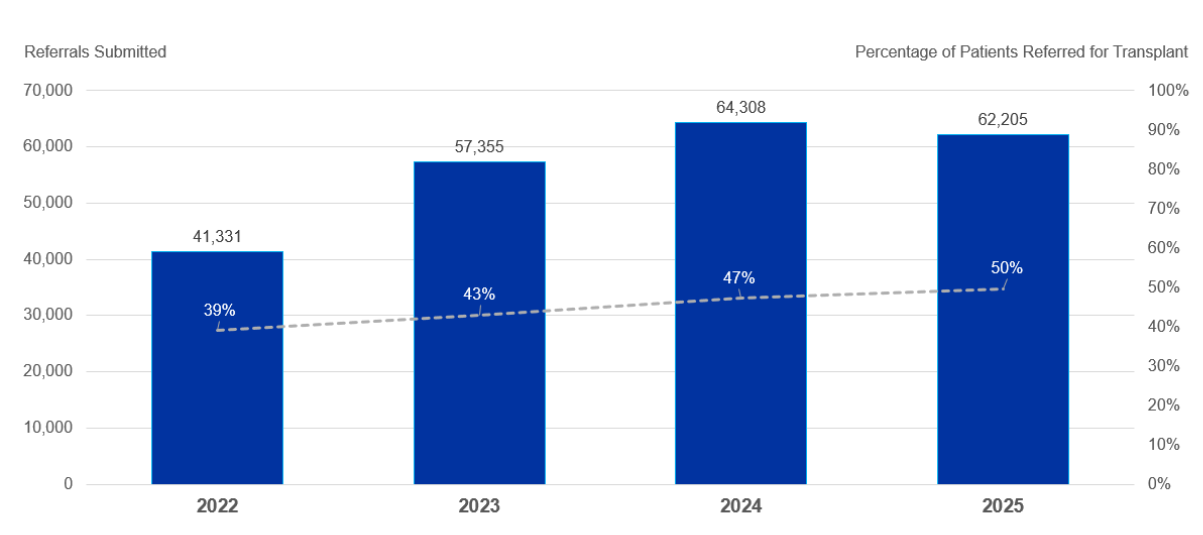
Referral Ready was deployed across the FME clinic network in April 2023. Since then, FME clinics have generated tens of thousands of transplant referrals annually, helping ensure that referral quality is not a barrier to the next steps in transplant evaluation (Fig. 1). 

The success of the elegant approach for Referral Ready for transplant referrals has also resulted in saving valuable staff time to reduce their paperwork burden and give them back more time to focus on the best part of our jobs: directly caring for patients. 

Figure 1. From 2022–2025, social workers submitted more transplant referral packets while referring a greater proportion of FKC patients to transplant centers, signaling sustained improvements in both productivity and proficiency.

Beyond Referral: Navigating the Path to Waitlisting

FME has been clear‑eyed about the limits of referral alone. Research and real‑world experience show that many patients who are referred for transplantation never begin an evaluation, and many who do begin never reach the waiting list.

In response, FME has begun focusing on the “in‑between” spaces of transplant access — helping patients navigate a process that is often complex, confusing, and slow, while respecting the clinical autonomy of transplant center partners. This work is ongoing, but it reflects a broader shift: accepting shared responsibility for patient progress rather than stopping at the point of referral.

Leading by Example: Supporting Living Donation and Patients’ Voices

FME aligns its internal practices with its external advocacy. FME is a proud supporter of the Living Donor Protection Act (S. 1552/ H.R. 4582 & H.R. 4583) which would grant living donors important insurance protections and job protected medical leave and calls on Congress to pass this important legislation. In 2022, the company joined the American Society of Transplantation Living Donor Circle of Excellence, introducing six weeks of 100% paid leave for North American employees who choose to become organ or bone marrow donors. By 2025, that benefit was expanded globally, covering more than 100,000 full‑time employees worldwide.

That same year, the Fresenius Medical Care Foundation supported a first‑of‑its‑kind study focused entirely on patient‑reported outcomes related to transplant immunosuppression. By centering patients’ own perspectives, the research highlighted unmet needs that are often invisible in traditional clinical endpoints — and underscored the importance of innovation that reflects what matters most to patients themselves.

Shaping the Future: Policy, Partnership, and Integration

The last decade has brought unprecedented change to U.S. transplant policy, and FME has worked to remain an active, constructive participant in that evolution. Through engagement with Medicare and policymakers, FME has contributed to discussions on transplant‑focused quality metrics, organ procurement organization reform, and payment models affecting transplant centers.

In 2024, FME articulated a comprehensive vision for future value‑based care models that more fully integrate transplant centers into end‑to‑end kidney care. While the ideas have continued to draw critique, the tone of the debate has shifted — toward collaboration, refinement, and shared problem‑solving.

Looking Ahead

FME is working to solve the challenges of kidney transplantation with a patient-centered and innovative approach. Over the past ten years, the company has consistently chosen engagement on complicated policy issues with partners from throughout the entire kidney care and transplant ecosystem to support the highest quality patient experience over institutional convenience.

Ultimately, our success will be measured in how many people with kidney disease receive the right care, at the right time, across the full arc of their lives. That remains the work ahead.